When Viva Goals Disappears – What Should You Choose Instead?
Share this article
Microsoft's retirement of Viva Goals in December 2025 forces thousands of organizations to find new paths for strategic goal management. But this is actually an opportunity to make a more thoughtful choice. A tool selection doesn't need to dictate your methodology. Instead, you should choose a strategic framework that genuinely reflects how businesses operate.
What's Happening with Viva Goals?
On December 31, 2025, Microsoft is shutting down Viva Goals. The service continues functioning until then, but the company has already stopped developing new features. For organizations that invested in the platform, this means a forced choice: either find a new system or, more importantly, consider whether you want to continue working the same way.
Microsoft continues developing other parts of the Viva suite. But Goals specifically is disappearing. This isn't a technical shutdown due to security issues or costs. It's a strategic decision that says something about the product's market impact. The decision doesn't come as a complete surprise to anyone following user feedback. Viva Goals has struggled with several fundamental problems since launch.
Why Did Viva Goals Fail?
The OKR framework that Viva Goals builds on has its limitations. Objectives and Key Results work well for certain types of organizations and certain types of goals. But many businesses discover the framework is too narrow. It focuses on goals and results, but says surprisingly little about everything else that actually needs to work for the goals to be achieved.
User reviews have pointed to concrete problems. The platform was often slow and unresponsive, creating frustration. It lacked functionality for recurring goals. Customization options for visualizations were limited. For a cloud service meant to facilitate daily work, it quickly became an obstacle instead. But the biggest problem wasn't technical. It was strategic. Viva Goals was sold as the solution to strategic goal management. Buy the system, fill in your OKRs, connect to your tools, and strategic work solves itself. It doesn't work that way. The tool came first, the methodology second. And when the methodology doesn't fit the business reality, it doesn't matter how good the Teams integrations are.
The Microsoft ecosystem lock-in also created vulnerability. Companies chose Viva Goals because it fit their existing Microsoft environment. Smart at the time. But it made them completely dependent on Microsoft's long-term priorities. When Microsoft decides Goals isn't strategically important anymore, users are left with data, processes, and established working methods that suddenly have no future. That's a lesson worth taking away.
Three Things to Consider Before Choosing a New System
1. Methodology Before Tools
Start by understanding how you want to work strategically. Not which system you should buy. It sounds obvious, but most organizations do the opposite. They look at available systems, compare features and prices, choose one, and then start adapting their strategic work to what the system offers. What's missing in many tools isn't dashboards or integrations. It's a methodology that actually reflects how businesses function. A methodology that accounts for strategic work being more than just setting goals and following up on them. It's about understanding the market, building the right capabilities, engaging employees, optimizing processes, and maintaining financial sustainability simultaneously. Ask yourselves: what do we need to understand and do to drive the business forward? Not: which fields can we fill in this system?
2. Holistic Perspective, Not Just Goals
The OKR framework focuses on objectives and key results. Fine. But what happens to everything else? What happens to your market understanding when competitors launch something new? What happens to employee engagement when people quit because you don't have a plan for competence development? What happens to operational quality when processes can't keep up with growth? A strategic methodology needs to cover the entire business. Not just the areas easy to measure in numbers.
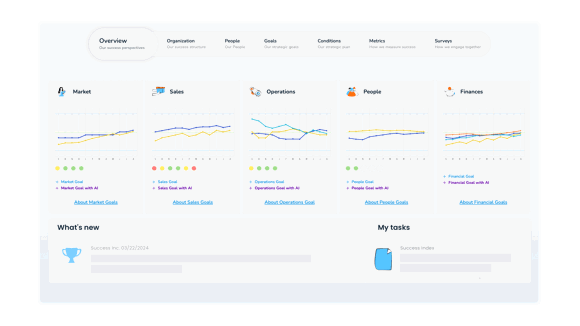
Most businesses have five fundamental areas that must function simultaneously: your market position, your sales and marketing, your internal operations, your employees, and your finances. Forget one of them and the strategy becomes incomplete. Focus only on goals and key results and you miss half the picture. A complete strategic framework covers all these areas. Not because it looks good on paper, but because it reflects reality.
3. Conditions Are More Important Than Tasks
Most systems help you track what needs to be done. Activities. Tasks. Projects. Fewer systems help you understand what must be in place for you to succeed at all. There's a difference between having a goal and having the conditions to reach it. You can set the goal "increase conversion by 30% next quarter" as many times as you want. But if your web platform is too slow, if your sales team lacks the right competence, and if no one really believes it's possible, then the goal doesn't matter.
Conditions are about three things: structure, capability, and energy.
Structure is the resources, systems, and processes that must function. The budget. The tools. The routines. Capability is the competence and knowledge needed. Can people do what's required? Do they have the right training, experience, and support? Energy is the driving force. Motivation. Engagement. Do people believe in this? Do they want to do it? Without these three in place, even the best goals become wishful thinking. A tool that doesn't help you identify and build conditions gives you half the truth.
What a Complete Strategic Framework Looks Like
A thoughtful framework for strategic planning builds on several core principles. Not theoretical ideals that sound good in presentations, but principles that actually hold when the business gets messy, when the market changes, and when people need to make decisions under pressure.
The Five Strategic Perspectives
Market, Sales, Operations, Employees, and Finance. Together they create a holistic picture where no strategic area is forgotten. Each perspective connects with the others, just like in a real business.
The Market perspective is about understanding the external environment. What do customers want? What are competitors doing? What trends are emerging? This is the foundation. Everything else builds on insights from here. If you don't understand the market, all other decisions will rest on guesswork.
The Sales perspective picks up where market understanding ends. How do you reach customers? How do you communicate value? How do you get them to choose you? This includes everything from brand and marketing to actual sales and customer care. It's not enough to know what the market wants, you must also be able to deliver the message.
The Operations perspective is about fulfilling promises. Processes. Flows. Tools. Quality. Delivery time. This is where the work gets done. When customers buy your products or services, it's operations that either delivers as promised or makes you empty words. A strategy that doesn't account for operational capability is doomed to fail.
The Employee perspective puts the team at the center. Engaged colleagues who share goals and values create power. Competence grows through challenges and support. Without people who can, will, and have the energy, strategy becomes just paper. You can have the world's best market strategy and the most optimized processes, but if employees don't keep up, it doesn't matter.
The Finance perspective ties the story together. The numbers show whether the plan holds, whether efforts bear fruit, and whether the future carries forward. This isn't just accounting and reports. It's the question of whether strategy leads to real results or whether you're burning money on projects that never provide returns.
All five perspectives are needed. Forget one and you get holes in the strategy. Focus only on finance and you miss why customers buy. Focus only on market and you forget employees must be able to deliver. A complete framework forces you to think about all parts simultaneously.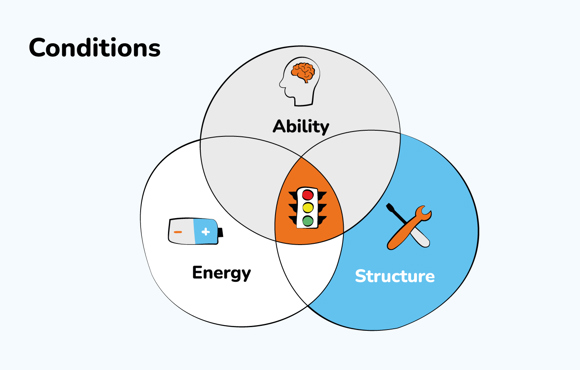
Focus on Conditions
Before you set goals, you ask: what needs to be in place? That's a different starting point than most systems offer. Most start with the goal and then work backward to activities. A more thoughtful way is to start by understanding what's actually required.
Structure is about resources and systems. Budget. Tools. Routines. Do you have what's needed to do the job? If the goal is to double online sales but the website crashes at 50 simultaneous visitors, then structure is missing. No amount of goal formulation fixes that.
Capability is about competence and knowledge. Can people do what's required? Do they have the right training? Right experience? Right support? If the goal is to launch a new product in an international market but no one on the team has done it before and no one gets time to learn, then capability is missing.
Energy is about motivation and drive. Do people believe in this? Do they want to do it? Do they have the stamina? If the goal is to transform the entire business but everyone is burned out after last year's reorganization and leadership hasn't communicated why this matters, then energy is missing. People will make minimum effort and the strategy dies in practice.
Without these three in place, even the best goals become wishful thinking. There's a difference between writing down a goal in a system and actually having what's required to reach it. A framework built on conditions forces you to be honest with yourselves before you set goals you can't reach.
The Traffic Light System
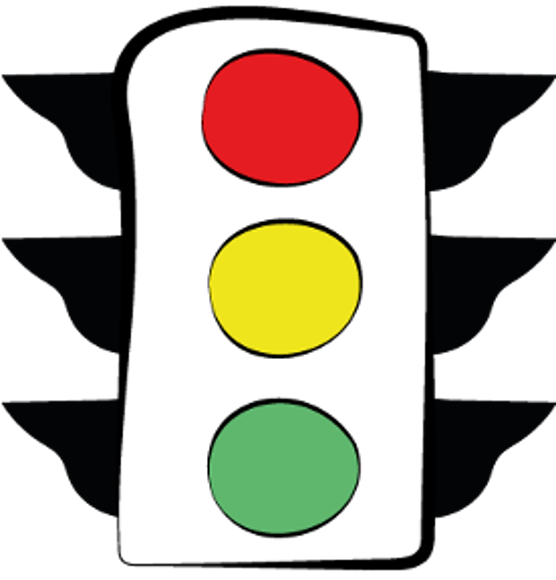
Simple status check that lets the entire organization quickly see where you stand. Red, yellow, green. No advanced formulas. No math. Just clarity that creates shared reality.
Green means it's working. The condition is in place, the goal is on track, nothing requires immediate action. People can focus on delivering instead of fighting fires.
Yellow means attention is needed. There are challenges that must be addressed. Not a crisis, but if you don't do something it will turn red soon. This is the signal to act before it's too late.
Red means danger. The condition is missing or in bad shape. The goal is in the danger zone. Immediate action required. This isn't time for long discussions, it's time for decisions and action.
Traffic lights work because they're universal. Everyone understands them immediately. When the leadership team gathers and sees the dashboard, no one needs to explain what the colors mean. When a team reports status to the rest of the organization, showing the color is enough. It creates transparency without bureaucracy.
Three Types of Measurement
Objective values, surveys, and condition indices. Different goals require different measurement methods. That's an insight many frameworks miss, they try to press everything into the same template.
Objective values are the numbers. Revenue, market share, delivery time, number of customers, conversion rate. Everything that can be counted. When the goal is quantifiable, this is the right way to measure. Simple, clear, comparable over time.
Surveys capture the qualitative. Customer satisfaction, employee engagement, brand perception. How people feel and think. It can't always be counted, but it can be asked. When the goal is about experiences or attitudes, this is the right tool.
Condition indices assess whether what's needed is in place. Do we have the budget? Does the competence exist? Is the motivation there? This isn't the same as measuring the goal's result, it's measuring whether you can reach it at all. One person assesses status and uses traffic lights to show the situation.
A strategic framework that only offers one type of measurement will force you to distort reality to fit the form. Sometimes you need numbers. Sometimes you need to hear what people think. Sometimes you simply need to know if you have what's required.
From Viva Goals to a Strategic Approach
If you're using Viva Goals today, you don't need to panic and switch systems. Instead, start by mapping how you actually want to work strategically. The system can wait. The methodology must come first.
1. Inventory Your Current Goals
Gather all the goals you have today. List them. Look at them as a whole, not just one at a time. Which perspectives do they cover? Do you have goals about market position? About sales and marketing? About internal processes? About employees? About finances?
You'll probably discover gaps. Maybe you have ten goals about sales but nothing about how employees will manage the pace. Maybe everything focuses on financial key figures but nothing on whether you actually understand what customers want. This isn't criticism of previous work, it's insight about where you need to strengthen. If any area is completely missing, that's a red flag. A strategy that doesn't cover all five perspectives isn't complete.
2. Identify Conditions
For each goal you have, ask: what needs to be in place for us to reach this? Not which activities we should do, but what must function first. Take a concrete example. Say you have the goal "increase recurring revenue from existing customers by 40% within 12 months." Good goal. But what's required?
Structure: Do you have a CRM system that actually tracks customer interactions? Does the budget exist to develop new product packages for existing customers? Do you have routines for regular contact?
Capability: Can the sales team actually upsell or are they only used to new customer sales? Does customer service have the competence to identify opportunities? Does everyone know which signals indicate a customer is ready for more?
Energy: Does the team believe it's possible? Are they motivated to change how they work? Do they have time and energy to focus here or is everyone already overloaded?
If the answer is no to several of these questions, the goal is practically impossible to reach, regardless of how nice it looks in the system. Identify the conditions first. Build them. Then you can start chasing the goal.
3. Choose Measurement Methods
Now that you know what you want to achieve and what needs to be in place, how will you follow up? Think through which type of measurement actually fits. If the goal is "increase market share in the Nordics" you need objective values. Concrete numbers on your share compared to competitors. Nothing else will do. If the goal is "strengthen our brand as an innovative partner" you need surveys. Ask customers what they think. Track media coverage. Measure perception, not just numbers. If the goal is "create a culture where employees dare test new ideas" you probably need both surveys and condition indices. How many new ideas are tested? How do people feel about it? Do structures exist that support experimentation? Don't try to force everything into the same form. Different goals require different ways to follow up.
4. Create Clear Responsibility Roles
Who owns which goal? Who follows up? It must be crystal clear. A goal without an owner is a goal no one takes responsibility for. It falls between the cracks and dies quietly. One person must be responsible for each strategic goal. Not a group, not a team, not "all of us." One person. That person drives the goal forward, gathers the right people, reports status, and ensures things happen. That doesn't mean the person does everything themselves. It means the person has the responsibility to ensure it gets done. Make the responsibility question clear before moving forward. Unclear responsibility roles are death for strategic work.
5. Visualize with Traffic Lights
Make status clear for the entire organization. Not just for the leadership team, but for everyone who needs to know. A dashboard with traffic lights gives shared reality in seconds. When something is green, everyone knows it's rolling on. When something is yellow, everyone knows attention is needed. When something is red, everyone knows we must act now. No one needs to read long reports or interpret complicated graphs. Transparency creates accountability. When everyone sees how different goals are going, it becomes harder to blame others or claim "it's going well anyway" when the traffic light shows red. When the methodology is ready, you can choose tools. Not the other way around. The system should support your way of working, not dictate it.
Common Questions About Switching from Viva Goals
Do we have to switch tools before December 2025?
No. Microsoft maintains the service until then. No panic needed. But use the time well. Instead of stressing about which new system to buy, consider how you actually want to work strategically. That's a bigger question. When you have the answer to that, choosing tools becomes much easier.
Can we continue with the OKR framework?
Absolutely, if it works for you. There are organizations where OKR fits perfectly. Often tech companies, project-driven firms, environments where goals are clearly quantifiable and everyone works toward the same type of results.
But think honestly about whether you need a broader perspective. If you notice your OKRs only cover certain parts of the business while others fall through the cracks, that's a sign. If you constantly have problems not captured by your objectives and key results, then maybe the framework is too narrow.
A broader framework covering the entire business doesn't mean you must throw away everything you learned about OKR. It means you add the parts that are missing.
What happens to our historical data from Viva Goals?
Make sure to export it before the deadline. Microsoft will probably offer export functions, but don't wait until the last week. Extract the data now. Put it somewhere safe.
Then, use it as learning material. Look at what you actually achieved. Which goals did you reach? Which did you miss? What was the difference? That's valuable information when building your new methodology. But don't make the mistake of just copying the same goals to a new system. Learn from the history, build something better.
Do we need to hire consultants to switch systems?
Not necessarily. Start by building internal understanding of how you want to work strategically. Gather the leadership team. Go through the five perspectives. Identify your most important goals. Map which conditions are required.
A clear framework makes implementation easier. If you know what you want to achieve and how you want to work, it becomes much easier to choose the right tools and set them up correctly. Consultants can be valuable for specific parts, especially if you lack internal competence in strategic work. But start internally. Build your own understanding first.
Is there a direct replacement for Viva Goals?
There are several systems offering similar functionality. But that's the wrong question. The question isn't which is closest to Viva Goals in features. The question is which framework and which way of working actually fits your business.
A system that looks different but supports a more thoughtful strategic approach is better than a system that looks exactly like Viva Goals but has the same limitations.
How long does it take to build a new methodology?
Count on a few months. Not because it's complicated, but because it requires reflection and discussion. You need to map the current situation, define where you want to go, and build conditions to get there. It doesn't happen in one workshop.
But don't stress either. It's better to take the time it takes and do it properly than to rush through and end up with the same problems in a new system. This is your chance to build something that actually works.
What do we do with all the integrations we built toward Viva Goals?
Document them. List which systems you connected, which data flowed, and why it was important. That information is valuable when building integrations in the next system.
But also ask yourselves: which integrations did we really need? Often you build connections because the system offers them, not because they actually add value. Take the opportunity to clean up. Keep the integrations that genuinely make work easier, skip the rest.
A Strategic Choice
When Viva Goals disappears, you're not just facing a system choice. You're facing a strategic choice. Will you replace one tool with another similar one? Or will you take the opportunity to build a more thoughtful way to work with strategy? Many organizations will choose the first alternative. Find something resembling Viva Goals, migrate the data, continue as usual. It's easiest in the short term. But it doesn't solve the underlying problems that made Viva Goals never quite work for you.
A complete strategic framework covers the entire business through five perspectives that must function simultaneously. It builds on conditions instead of just activities, which forces you to be honest about what's actually required to reach your goals. It creates shared reality through clear visualization that lets everyone quickly see how things are going. This isn't a question about software. It's a question about how you lead your organization forward. Tools come and go. Microsoft launches services and shuts them down. New systems pop up, get hyped, and disappear. If your strategic work is tied to a specific tool, you become vulnerable to such changes. But if you build a thoughtful way to work strategically, a framework that actually reflects how businesses function, then tools matter less. They become support for the methodology, not the methodology itself.
So start with the methodology. Understand how you want to work. Build the conditions. Then you can choose any system that supports that way of working. When Viva Goals disappears in December, you'll have already moved forward. Not to a new tool, but to a better way to lead your business.
Read more:


